 Add to Chrome
 Add to Firefox
 Add to Edge
MetaDNS: Enhancing Exploration in Discrete Neural Samplers via Well-Tempered Metadynamics
May 20, 2026
Sampling from discrete distributions with multiple modes and energy barriers is fundamental to machine learning and computational physics. Recent discrete neural samplers like MDNS suffer from mode collapse and fail to sample high-energy barrier regions between modes, which is critical for free energy estimation and understanding phase transitions. We propose Metadynamics Discrete Neural Sampler (MetaDNS), a general framework integrating well-tempered metadynamics into discrete diffusion or autoregressive samplers. By maintaining an adaptive, history-dependent bias potential along selected low-dimensional coordinates, MetaDNS forces exploration of previously inaccessible regions, enabling free energy reconstruction infeasible with standard neural samplers due to a lack of high-energy samples. On challenging low-temperature benchmarks including Ising, Potts, and the copper-gold binary alloy, MetaDNS reproduces the thermodynamic distribution. Compared to MCMC-based metadynamics, MetaDNS also achieves comparable exploration requiring fewer bias deposition steps.

Computational Design and Experimental Validation of Photoactive PARP1 Inhibitors
Apr 27, 2026Light-activated drugs are a promising way to treat localized diseases for which existing treatments have severe side effects. However, their development is complicated by the set of photophysical and biological properties that must be simultaneously optimized. Here we used computational techniques to find a set of promising candidates for the photoactive inhibition of the poly(ADP-ribose) polymerase 1 (PARP1) cancer target. Using our recently developed methods based on atomistic simulation and machine learning (ML), we screened a set of 5 million hypothetical photoactive ligands. Our workflow used protein-ligand docking to identify candidates with differential PARP1 binding under light and dark conditions; ML force fields and quantum chemistry calculations to predict p$K_\mathrm{a}$, absorption spectra, and thermal half-lives; graph-based surrogate models to screen additional compounds; excited-state nonadiabatic dynamics with ML force fields to estimate quantum yields; and free energy perturbation (FEP) to refine binding predictions. From these predictions, we prioritized a small set of synthetically feasible candidates expected to have red-shifted absorption spectra, thermal half-lives on the order of seconds to minutes, and isomer-dependent PARP1 binding under visible-light control. We synthesized 10 candidates and experimentally characterized their photobehavior and PARP1 inhibition constants. Among the validated compounds, \textbf{1} showed a 15-fold increase in inhibition of PARP1 upon green-light irradiation at 519 nm (208.8 $\pm$ 28.3 $μ$M vs 14.4 $\pm$ 1.9 $μ$M). These results validate the computation-guided screening strategy for identifying red-shifted PARP1 photoinhibitors, while also underscoring current limitations such as rapid thermal relaxation in aqueous media.
A Priori Sampling of Transition States with Guided Diffusion
Mar 26, 2026Transition states, the first-order saddle points on the potential energy surfaces, govern the kinetics and mechanisms of chemical reactions and conformational changes. Locating them is challenging because transition pathways are topologically complex and can proceed via an ensemble of diverse routes. Existing methods address these challenges by introducing heuristic assumptions about the pathway or reaction coordinates, which limits their applicability when a good initial guess is unavailable or when the guess precludes alternative, potentially relevant pathways. We propose to bypass such heuristic limitations by introducing ASTRA, A Priori Sampling of TRAnsition States with Guided Diffusion, which reframes the transition state search as an inference-time scaling problem for generative models. ASTRA trains a score-based diffusion model on configurations from known metastable states. Then, ASTRA guides inference toward the isodensity surface separating the basins of metastable states via a principled composition of conditional scores. A Score-Aligned Ascent (SAA) process then approximates a reaction coordinate from the difference between conditioned scores and combines it with physical forces to drive convergence onto first-order transition states. Validated on benchmarks from 2D potentials to biomolecular conformational changes and chemical reaction, ASTRA locates transition states with high precision and discovers multiple reaction pathways, enabling mechanistic studies of complex molecular systems.
Scaling Autoregressive Models for Lattice Thermodynamics
Mar 16, 2026Predicting how materials behave under realistic conditions requires understanding the statistical distribution of atomic configurations on crystal lattices, a problem central to alloy design, catalysis, and the study of phase transitions. Traditional Markov-chain Monte Carlo sampling suffers from slow convergence and critical slowing down near phase transitions, motivating the use of generative models that directly learn the thermodynamic distribution. Existing autoregressive models (ARMs), however, generate configurations in a fixed sequential order and incur high memory and training costs, limiting their applicability to realistic systems. Here, we develop a framework combining any-order ARMs, which generate configurations flexibly by conditioning on any known subset of lattice sites, with marginalization models (MAMs), which approximate the probability of any partial configuration in a single forward pass and substantially reduce memory requirements. This combination enables models trained on smaller lattices to be reused for sampling larger systems, while supporting expressive Transformer architectures with lattice-aware positional encodings at manageable computational cost. We demonstrate that Transformer-based any-order MAMs achieve more accurate free energies than multilayer perceptron-based ARMs on both the two-dimensional Ising model and CuAu alloys, faithfully capturing phase transitions and critical behavior. Overall, our framework scales from $10 \times 10$ to $20 \times 20$ Ising systems and from $2 \times 2 \times 4$ to $4 \times 4 \times 8$ CuAu supercells at reduced computational cost compared to conventional sampling methods.
Discrete Adjoint Schrödinger Bridge Sampler
Feb 09, 2026Learning discrete neural samplers is challenging due to the lack of gradients and combinatorial complexity. While stochastic optimal control (SOC) and Schrödinger bridge (SB) provide principled solutions, efficient SOC solvers like adjoint matching (AM), which excel in continuous domains, remain unexplored for discrete spaces. We bridge this gap by revealing that the core mechanism of AM is $\mathit{state}\text{-}\mathit{space~agnostic}$, and introduce $\mathbf{discrete~ASBS}$, a unified framework that extends AM and adjoint Schrödinger bridge sampler (ASBS) to discrete spaces. Theoretically, we analyze the optimality conditions of the discrete SB problem and its connection to SOC, identifying a necessary cyclic group structure on the state space to enable this extension. Empirically, discrete ASBS achieves competitive sample quality with significant advantages in training efficiency and scalability.
FragmentFlow: Scalable Transition State Generation for Large Molecules
Feb 02, 2026Transition states (TSs) are central to understanding and quantitatively predicting chemical reactivity and reaction mechanisms. Although traditional TS generation methods are computationally expensive, recent generative modeling approaches have enabled chemically meaningful TS prediction for relatively small molecules. However, these methods fail to generalize to practically relevant reaction substrates because of distribution shifts induced by increasing molecular sizes. Furthermore, TS geometries for larger molecules are not available at scale, making it infeasible to train generative models from scratch on such molecules. To address these challenges, we introduce FragmentFlow: a divide-and-conquer approach that trains a generative model to predict TS geometries for the reactive core atoms, which define the reaction mechanism. The full TS structure is then reconstructed by re-attaching substituent fragments to the predicted core. By operating on reactive cores, whose size and composition remain relatively invariant across molecular contexts, FragmentFlow mitigates distribution shifts in generative modeling. Evaluated on a new curated dataset of reactions involving reactants with up to 33 heavy atoms, FragmentFlow correctly identifies 90% of TSs while requiring 30% fewer saddle-point optimization steps than classical initialization schemes. These results point toward scalable TS generation for high-throughput reactivity studies.
Learning Collective Variables from Time-lagged Generation
Jul 10, 2025Rare events such as state transitions are difficult to observe directly with molecular dynamics simulations due to long timescales. Enhanced sampling techniques overcome this by introducing biases along carefully chosen low-dimensional features, known as collective variables (CVs), which capture the slow degrees of freedom. Machine learning approaches (MLCVs) have automated CV discovery, but existing methods typically focus on discriminating meta-stable states without fully encoding the detailed dynamics essential for accurate sampling. We propose TLC, a framework that learns CVs directly from time-lagged conditions of a generative model. Instead of modeling the static Boltzmann distribution, TLC models a time-lagged conditional distribution yielding CVs to capture the slow dynamic behavior. We validate TLC on the Alanine Dipeptide system using two CV-based enhanced sampling tasks: (i) steered molecular dynamics (SMD) and (ii) on-the-fly probability enhanced sampling (OPES), demonstrating equal or superior performance compared to existing MLCV methods in both transition path sampling and state discrimination.
Transferable Learning of Reaction Pathways from Geometric Priors
Apr 21, 2025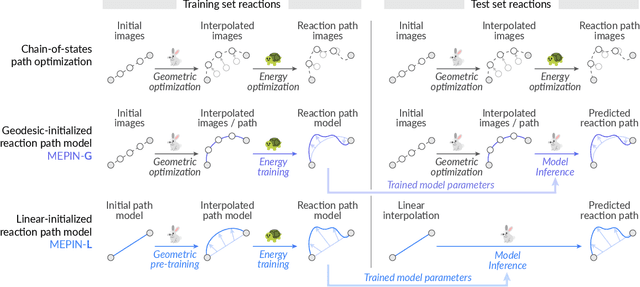
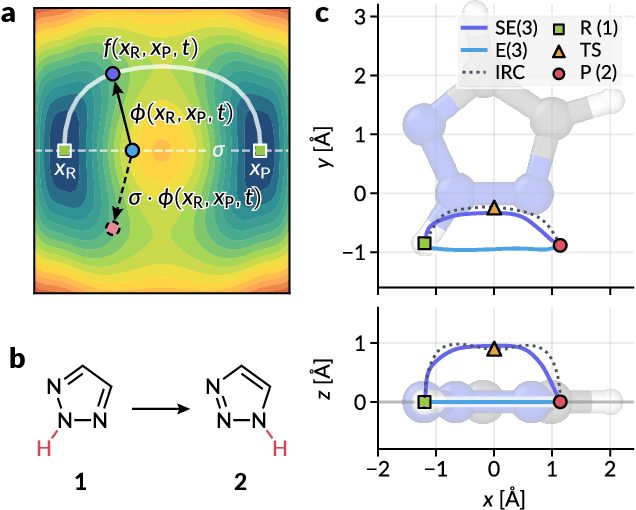
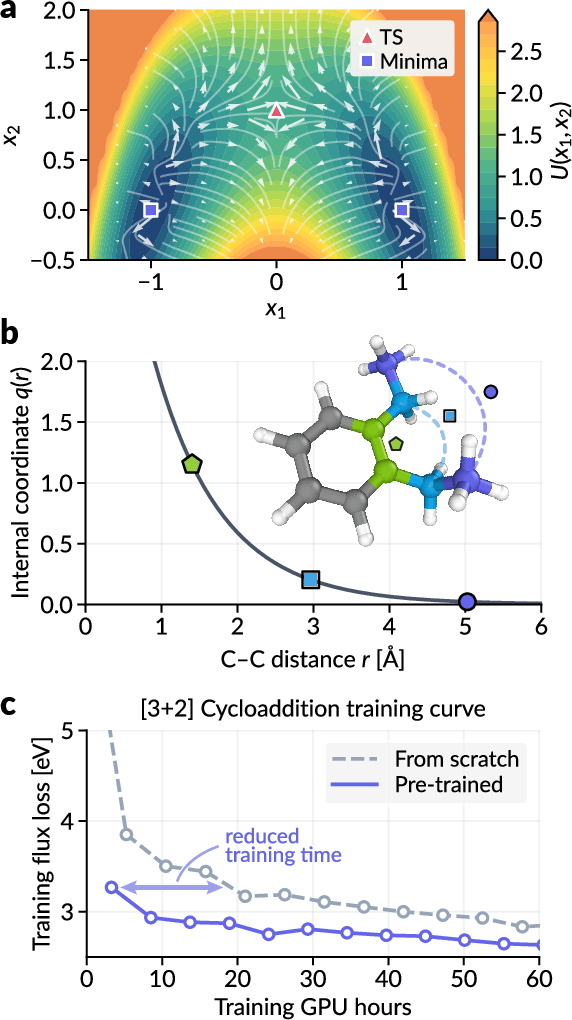
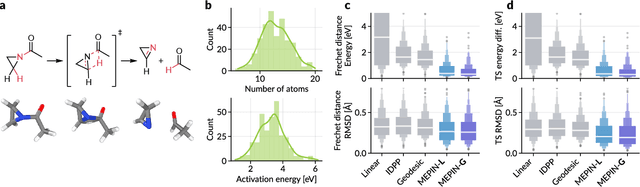
Identifying minimum-energy paths (MEPs) is crucial for understanding chemical reaction mechanisms but remains computationally demanding. We introduce MEPIN, a scalable machine-learning method for efficiently predicting MEPs from reactant and product configurations, without relying on transition-state geometries or pre-optimized reaction paths during training. The task is defined as predicting deviations from geometric interpolations along reaction coordinates. We address this task with a continuous reaction path model based on a symmetry-broken equivariant neural network that generates a flexible number of intermediate structures. The model is trained using an energy-based objective, with efficiency enhanced by incorporating geometric priors from geodesic interpolation as initial interpolations or pre-training objectives. Our approach generalizes across diverse chemical reactions and achieves accurate alignment with reference intrinsic reaction coordinates, as demonstrated on various small molecule reactions and [3+2] cycloadditions. Our method enables the exploration of large chemical reaction spaces with efficient, data-driven predictions of reaction pathways.
Symmetry-Constrained Generation of Diverse Low-Bandgap Molecules with Monte Carlo Tree Search
Oct 11, 2024


Organic optoelectronic materials are a promising avenue for next-generation electronic devices due to their solution processability, mechanical flexibility, and tunable electronic properties. In particular, near-infrared (NIR) sensitive molecules have unique applications in night-vision equipment and biomedical imaging. Molecular engineering has played a crucial role in developing non-fullerene acceptors (NFAs) such as the Y-series molecules, which have significantly improved the power conversion efficiency (PCE) of solar cells and enhanced spectral coverage in the NIR region. However, systematically designing molecules with targeted optoelectronic properties while ensuring synthetic accessibility remains a challenge. To address this, we leverage structural priors from domain-focused, patent-mined datasets of organic electronic molecules using a symmetry-aware fragment decomposition algorithm and a fragment-constrained Monte Carlo Tree Search (MCTS) generator. Our approach generates candidates that retain symmetry constraints from the patent dataset, while also exhibiting red-shifted absorption, as validated by TD-DFT calculations.
Efficient Generation of Molecular Clusters with Dual-Scale Equivariant Flow Matching
Oct 10, 2024Amorphous molecular solids offer a promising alternative to inorganic semiconductors, owing to their mechanical flexibility and solution processability. The packing structure of these materials plays a crucial role in determining their electronic and transport properties, which are key to enhancing the efficiency of devices like organic solar cells (OSCs). However, obtaining these optoelectronic properties computationally requires molecular dynamics (MD) simulations to generate a conformational ensemble, a process that can be computationally expensive due to the large system sizes involved. Recent advances have focused on using generative models, particularly flow-based models as Boltzmann generators, to improve the efficiency of MD sampling. In this work, we developed a dual-scale flow matching method that separates training and inference into coarse-grained and all-atom stages and enhances both the accuracy and efficiency of standard flow matching samplers. We demonstrate the effectiveness of this method on a dataset of Y6 molecular clusters obtained through MD simulations, and we benchmark its efficiency and accuracy against single-scale flow matching methods.